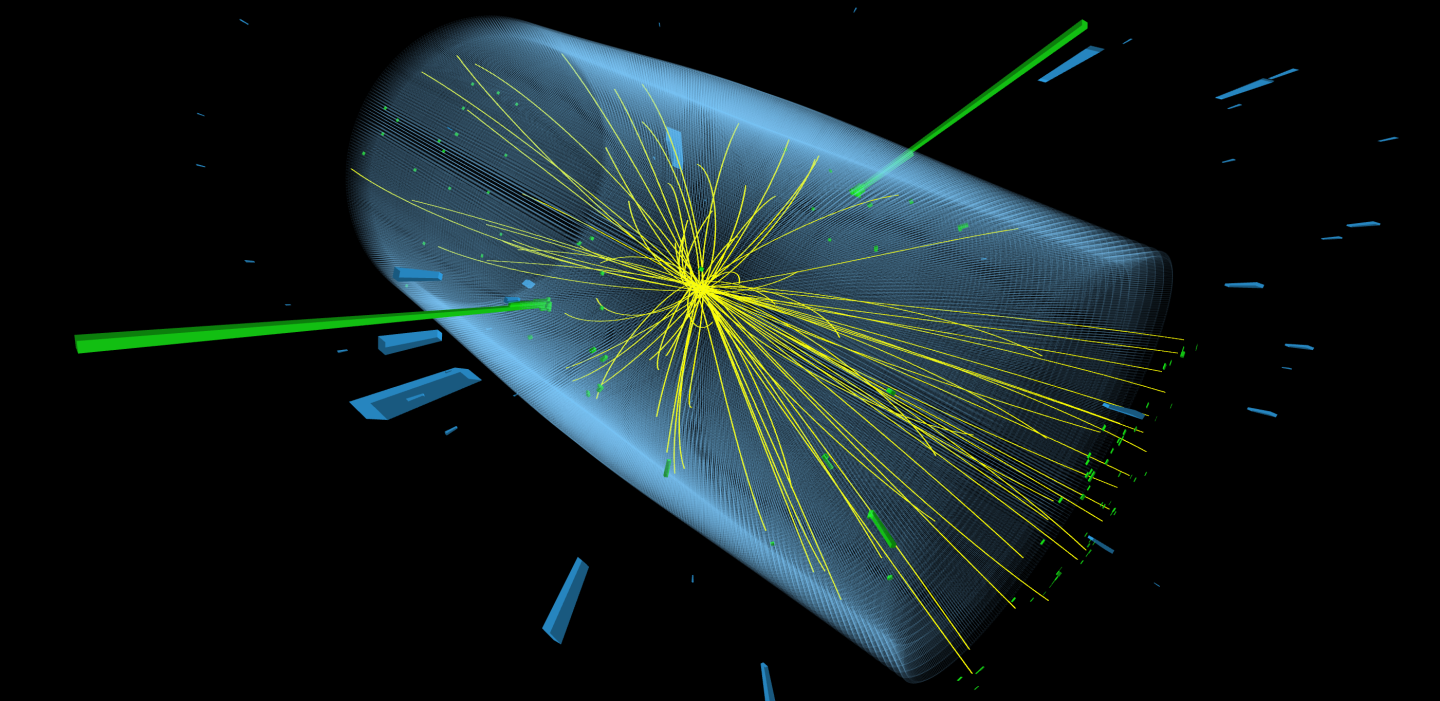
Elementary particle physics studies the fundamental constituents of matter and the interactions that govern their behavior. The current theoretical framework, the Standard Model of particle physics, describes with great precision a wide variety of experimental phenomena down to distance scales of order 10-17 cm. However, it leaves open fundamental questions, such as the nature of dark matter, the origin of neutrino masses, and the origin of the electroweak scale, among others. We investigate both extensions of the Standard Model and the dynamics of strongly interacting matter under extreme conditions, combining analytical and computational tools to connect theoretical models with observables at high-energy colliders such as the Large Hadron Collider (LHC).
Among the topics we study are physics beyond the Standard Model, including lepton number and lepton flavor violation, neutrino physics, the phenomenology of supersymmetric models, extended Higgs sectors, and models that provide candidates for dark matter. We also apply effective field theories and renormalization group techniques to establish model-independent limits on the parameters of new physics. In the area of heavy-ion collisions, we investigate the properties of the quark–gluon plasma (QGP) under extreme conditions of temperature, baryon asymmetry, angular momentum, and anisotropy, studying its transport coefficients in order to characterize the evolution of the medium.