Since January 2024, Dr. Ximena Ramos has been part of the Multidisciplinary Center for Physics (CMF) at Universidad Mayor. With a solid track record and a PhD in Astronomy from the National University of Córdoba, Argentina, the researcher is currently leading the development of a tool known as the Co-Moving Framework.
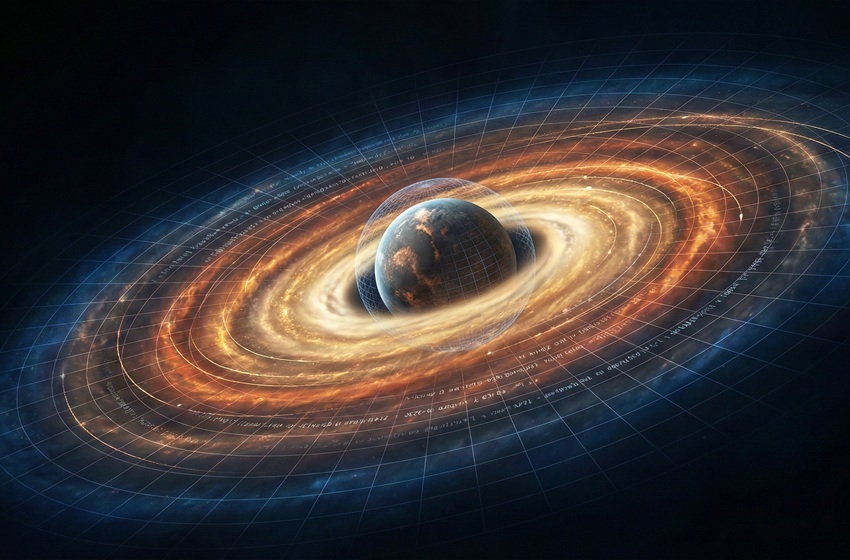
This advance makes it possible to deepen the study of planetary migration—the fundamental process by which planets move and shape their surroundings within the dense disks of gas and dust that encircle young stars.
The research, entitled “A Moving Framework for Planet Migration,” was developed in collaboration with astrophysicist Dr. Pablo Benítez and proposes an innovative mathematical model that allows for the precise reconstruction of how the various planetary systems known beyond our Solar System are born and evolve.
As the academic explains, the challenge of these models is enormous due to the timescales and technical demands involved. “The Solar System is 4.5 billion years old. The systems we are studying are much younger, and simulating them to understand where they come from and how they form is extremely complex—not only in terms of physics, but also computationally,” she says.
To help convey this complex process, the researcher uses an analogy: it is as if a planet were a person moving forward with a camera on their head. While traditional methods observe motion from a fixed point, her approach relies on this “mobile camera,” making it possible to clearly observe how the particles surrounding the planet move along its entire path, even as the planet itself migrates. “Our camera follows the planet throughout its journey as it forms,” she explains.
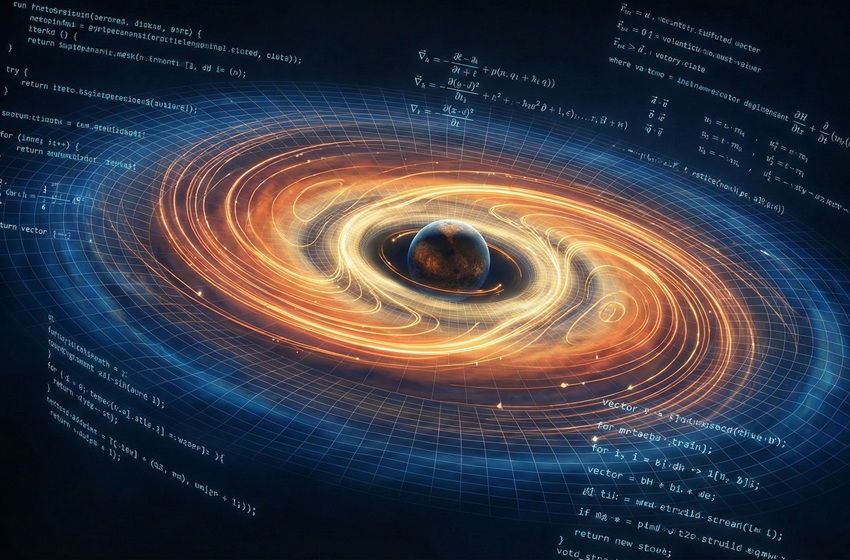
This pursuit of efficiency has been the driving force behind the project. As Dr. Ramos notes, “for several years we have been searching for ways to simulate these planetary systems at computationally feasible levels using different methods, and that is essentially how the idea of this Co-Moving Framework was born.”
Among the strengths of this methodology—published in The Astrophysical Journal—is a dramatic increase in the speed of numerical simulations, which can be up to ten times faster than conventional simulations for planets undergoing significant migration. This means that calculations that once took weeks can now be completed in a matter of days.
This advance not only optimizes resources, but also enables studies that were previously prohibitive. “This work allows us to carry out simulations of planetary systems over very large spatial and temporal scales. It is a crucial step toward building a comprehensive theory that explains the origin of the immense diversity of planetary systems discovered in our galaxy,” the academic adds.
With this development, Universidad Mayor positions itself at the forefront of theoretical and computational astronomy, contributing key tools to understand the architecture of the universe.
Link to the news article